


Abstract
Existing diffusion-based methods have recently made significant progress in image dehazing. However, they typically neglect the physics of haze formation and reconstruct clean images from pure Gaussian noise, thereby limiting their restoration potential. To address this issue, we propose Haze-Noise Diffusion (HNDiff), a novel diffusion framework that embeds the atmospheric scattering model as an inductive bias. By grounding diffusion in physical principles, HNDiff ensures that the restoration aligns more closely with underlying mechanisms of haze formation. In its forward process, we introduce joint haze-noise diffusion with a haze-aware noise scheduler, which progressively adds both haze and noise to an image. Essentially, the scheduler adapts noise levels according to haze density, meaning that regions with heavier haze receive stronger noise injection to encourage content generation, while clearer regions receive lighter noise to better preserve details, which directly links the forward degradation process with the physics of haze. In the reverse process, we then derive a physically consistent dehazing-denoising process that simultaneously removes haze and noise to restore a clean image in a manner aligned with the forward degradation process. To further enhance practicality, we propose Latent HNDiff, which compiles clean latent priors that can be seamlessly integrated into existing dehazing networks to boost performance. Extensive experiments show that our work significantly improves leading dehazing backbones and achieves state-of-the-art results on benchmark datasets.
Results
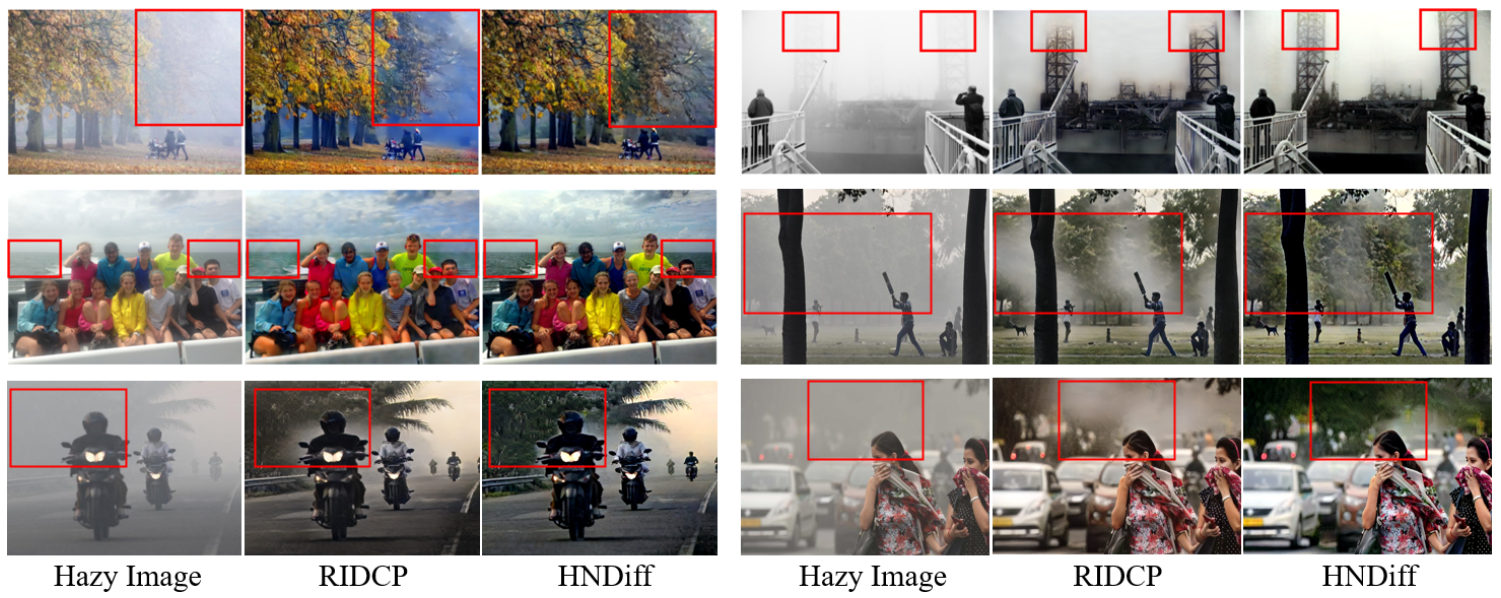 Qualitative results on the RTTS dataset.
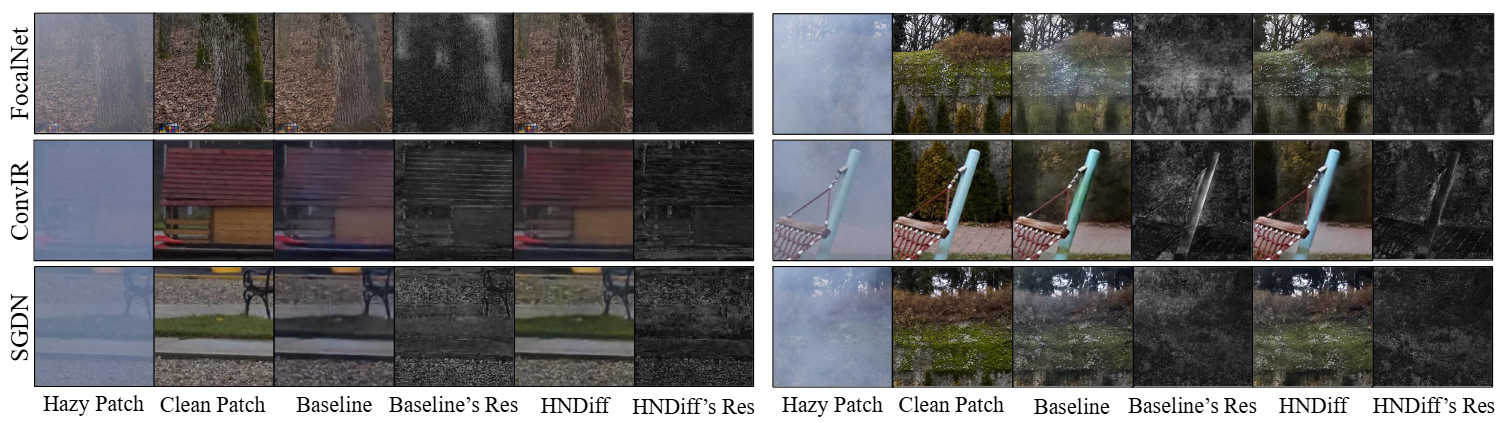 Qualitative results on the O-HAZE (left) and NH-HAZE (right) datasets. “Res” denotes residual maps between outputs and ground truth, where darker intensities indicate smaller errors.
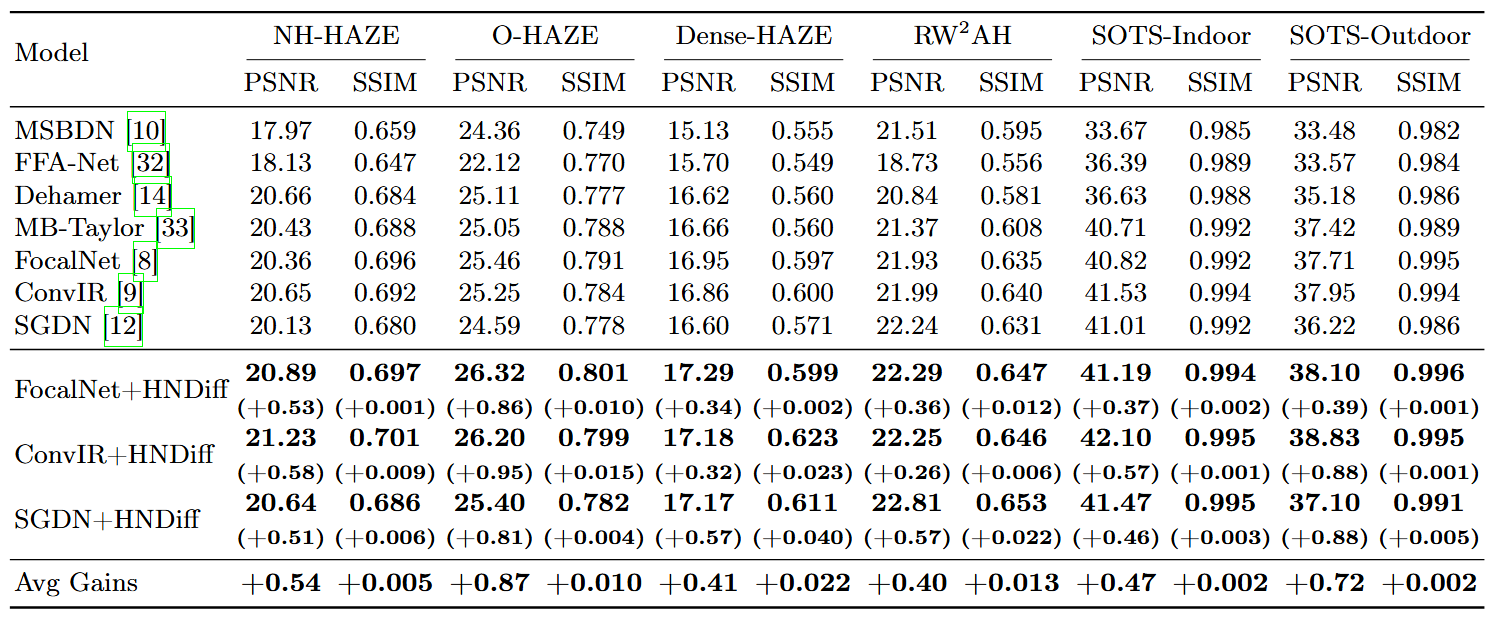 Quantitative results on six benchmark datasets. Values in parentheses represent the improvements of HNDiff over the corresponding baselines.
Overview
HNDiff leverages the ASM inductive bias, progressively adding haze and noise in the forward process and removing them in the reverse process for image dehazing.
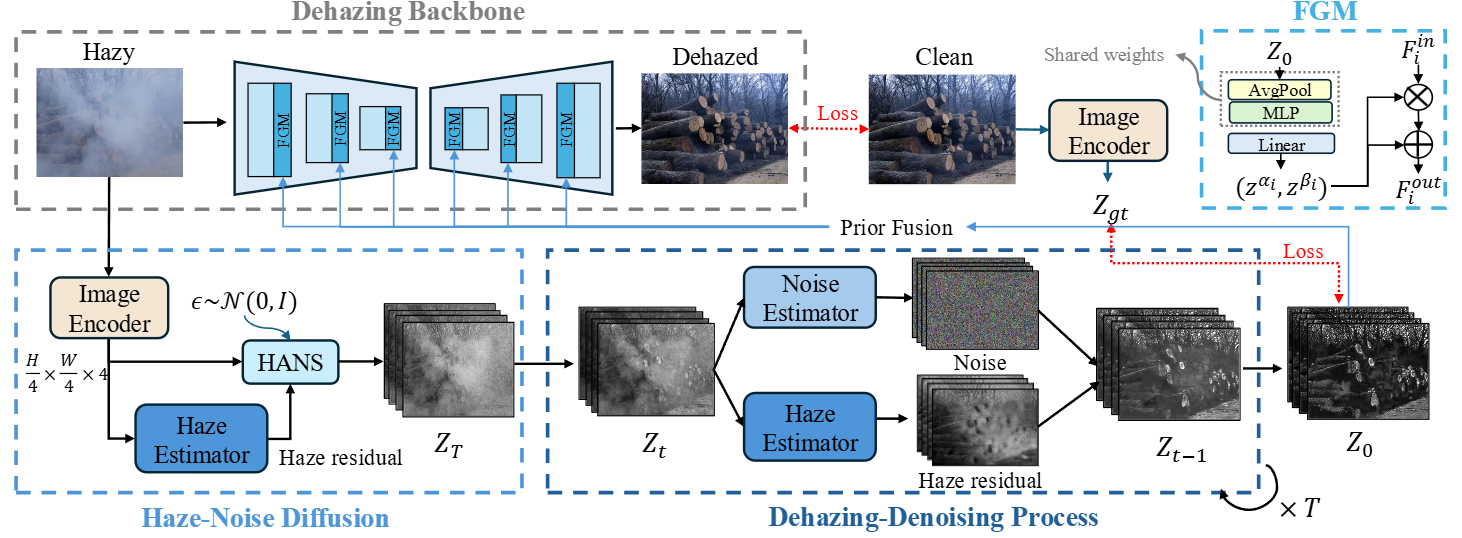 Overview of Latent HNDiff. The framework starts by using an image encoder to extract latent priors from a hazy input. These priors undergo a haze-noise diffusion process to produce the diffused hazy and noisy representation $Z_T$. During the reverse process, dehazing and denoising are performed jointly by iteratively estimating both noise and haze residuals to recover clean priors $Z_0$. Lastly, the recovered priors are integrated into a dehazing backbone via the Feature Gating Module (FGM) to improve restoration quality.
Related Low-Level Vision Works
You may also be interested in our previous work on low-level vision:
-
BlurDM: A Blur Diffusion Model for Image Deblurring — NeurIPS 2025 · Paper
-
Domain-adaptive Video Deblurring via Test-time Blurring — ECCV 2024 · Paper
Citation
TODO